
Your crews are busy. Your calendar is full. So why does profit keep disappearing?
You did not start a landscaping business to spend your evenings buried in spreadsheets and second-guessing your bids. But if you are still estimating the way you did five years ago, your process is almost certainly costing you thousands every season. This guide uses real industry data and contractor stories to show you where the money goes — and how the right tools bring it back.
Estimated read time: 25 minutes
1. Busy does not mean profitable: the landscape job costing gap
The U.S. landscaping industry reached $188.8 billion in 2025, with nearly 692,000 businesses competing for work (IBISWorld, National Association of Landscape Professionals). Demand is not the problem. Crews are running, trucks are rolling, and schedules are booked solid across the country.
Yet approximately 50 percent of landscaping businesses fail within their first five years (Grow Group, 2025). The reason is rarely a lack of work. It is a lack of profit. And the root of that problem almost always traces back to how jobs are priced before a single shovel hits the ground.
Why do profitable landscapers sometimes feel broke?
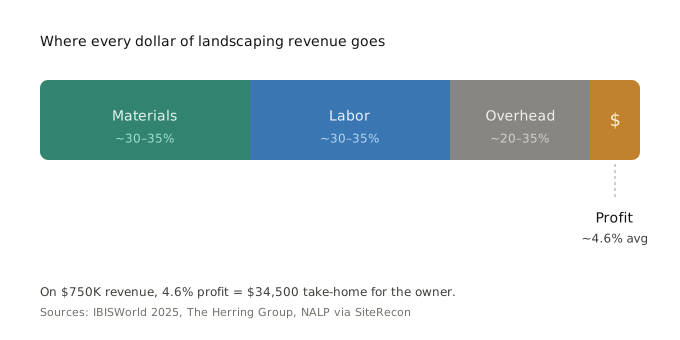
The answer often comes down to one overlooked number: net profit margin. IBISWorld puts the industry-wide average at 11.9 percent for 2025, but that figure is pulled upward by the largest and most efficient operations. For the typical landscape company, Greg Herring of The Herring Group benchmarks the average net profit at just 4.6 percent.
On $750,000 in annual revenue, 4.6 percent net profit is $34,500. That is what the owner takes home after a full year of risk, stress, and long weeks. A business can be busy every single day and still leave its owner financially stuck.
The gap between industry-reported margins and what most contractors actually experience is not random. It is structural. It comes down to whether your estimating and pricing systems are capturing every dollar your work is worth — or letting profit leak out on every job.
What the latest research reveals about estimating tools and profit margins
The Aspire 2026 Technology Trends Report, conducted by Thrive Analytics with over 500 commercial landscaping professionals, put a sharp number on this gap. Among contractors relying on manual estimating tools — paper, calculators, basic apps — zero reported profit margins above 15 percent. None.
Spreadsheet users clustered heavily in the 4 to 7 percent margin range, and only 9 percent of them reached margins above 11 percent (Aspire 2026 Technology Trends Report). Meanwhile, one in five contractors using an integrated estimating platform reported margins above 11 percent, and 49 percent forecast profit growth for the year ahead.
The tool you use to estimate does not guarantee your margin. But the data is clear: contractors using manual methods are consistently stuck at the bottom of the profitability range, while those using purpose-built software are far more likely to reach the margins that make business ownership worthwhile.
How your estimating process connects directly to your bottom line
Landscaping businesses only profit on approximately 60 percent of their jobs. Roughly 20 percent break even, and another 20 percent are outright losses (Total Landscape Care via Method.me). That means for every five jobs you complete, one is actively draining money from your business — and you may not know which one until it is too late.
The estimate is where profit is made or lost. It is the first financial decision on every job, and it cascades through everything that follows: crew scheduling, material purchasing, client expectations, and your final margin. When the estimate is wrong, the rest of the job inherits that error.
This is what landscape job costing reveals. Not just whether a job was “good” or “bad,” but precisely where the pricing went right or wrong — and how to correct it on the next bid. Without that feedback loop, you repeat the same pricing mistakes season after season.
"Among contractors relying on manual estimating tools, zero reported profit margins above 15 percent."
— Aspire 2026 Technology Trends Report, Thrive Analytics (500+ respondents)
Recognizing the gap between busy and profitable is the first step. The next is putting real numbers on what that gap costs you every year.
2. What inaccurate estimates cost your landscaping business every year
The cost of a bad estimate is not just one lost job. It is a pattern — a slow leak that drains profit across an entire season without ever showing up as a single line item. Most contractors sense something is wrong but cannot point to the exact cause. When you put hard numbers on the problem, the scale becomes difficult to ignore.
How underpricing 20 percent of your jobs compounds over a season
Tony Bass of Super Lawn Trucks has reviewed the financials of more than 400 lawn and landscape companies. His consistent finding: the average company underprices approximately 20 percent of its jobs (Tony Bass, Super Lawn Trucks).
On a business generating $500,000 in annual revenue, 20 percent of jobs represents $100,000 worth of work. If those jobs are underpriced by even 10 percent, that is $10,000 in revenue that never reaches your bank account. At 15 percent underpricing, it climbs to $15,000 — gone before you notice.
Now layer on another reality: up to 75 percent of estimates do not result in a signed contract at all (RapidQuote, citing university research). You are spending significant time creating bids you will not win. And when you do win, one in five of those jobs may be priced below your true cost. The combination is punishing: high effort on the estimating side, thin margins on the jobs you actually land.
The overhead allocation gap most contractors never see
A 2023 Lawn & Landscape survey found that 52 percent of contractors missed their profitability targets due to inaccurate overhead allocation in their estimates (2023 Lawn & Landscape Survey, via SiteRecon).
Overhead costs — insurance, vehicle expenses, equipment depreciation, office rent, admin salaries, software subscriptions — typically account for 20 to 35 percent of landscaping revenue. For businesses generating under $1 million annually, overhead can reach 40 percent (NALP via SiteRecon).
If you are not allocating overhead into every estimate, you are effectively subsidizing each job from your own pocket. The individual job looks profitable because it covers materials and labor. But the truck that carried the crew, the insurance that covered the site, and the phone bill that booked the client were never accounted for. That gap between apparent profit and real profit is where businesses slowly go under — not with one bad job, but with hundreds of slightly underpriced ones.
What bad data costs when the numbers are wrong from the start
A joint study by Autodesk and FMI Corporation, surveying over 3,900 construction professionals, found that bad data may have cost the global construction industry $1.85 trillion in 2020. Of that total, $88.69 billion in rework — representing 14 percent of all rework performed that year — was directly attributed to decisions made using inaccurate data (Autodesk/FMI Corporation).
Landscaping is not exempt from this pattern. Every estimate is a data exercise: material quantities, labor hours, crew production rates, overhead percentages, markup targets. When any of these inputs are wrong, the output — your bid price — is wrong. And unlike a structural engineering error that becomes visible on inspection, a pricing error often goes completely unnoticed until the season ends and the bank account tells the real story.
The compounding effect matters. One incorrect material cost in a template gets replicated across every estimate that uses it. A labor rate that was accurate two years ago quietly erodes your margin on every job today. Bad data does not announce itself. It simply makes every number downstream a little less true.
"I have taken the hit on around $10,000–$20,000 this year and have not charged the customers for it since I do not want to be 'that' contractor."
— Anonymous contractor, LawnSite
These numbers add up fast. And the tool most contractors rely on to prevent these losses — the spreadsheet — may be making the problem worse.
3. Why your landscaping estimate template stops working as you grow
Spreadsheets are not inherently bad estimating tools. If you started your business with an Excel template and a calculator, that was a reasonable choice. It kept costs low, let you move quickly, and gave you a system you could control entirely.
The problem is not where you started. The problem is that spreadsheets have a ceiling — and most contractors hit it well before they realize what is holding them back. Validating your past choices and recognizing when you have outgrown them are not contradictory. They are both necessary.
The formula error rate that should concern every contractor
Dr. Ray Panko of the University of Hawaii has spent decades studying spreadsheet reliability across industries. His research, spanning multiple field audits, found that 88 to 94 percent of spreadsheets contain at least one error (Ray Panko, University of Hawaii).
In an estimating context, a formula error means a wrong price on your proposal. It could be a misplaced decimal in a material cost, a labor rate that references the wrong cell, or an overhead multiplier that someone accidentally overwrote two months ago. Spreadsheets do not flag these problems. They calculate whatever you tell them to calculate — right or wrong — with equal confidence.
A landscaping estimate template is only as reliable as every formula, cell reference, and manually entered number within it. When nearly nine out of ten spreadsheets contain errors, the question is not whether your template has a mistake. It is how much that mistake is costing you per job, per week, per season.
Version control: when last month's prices cost you this month's profit
Spreadsheet estimating creates a version control problem that grows with every season. Material prices change quarterly. Labor rates increase with new hires and wage adjustments. Your overhead shifts as you add trucks, hire office staff, or take on a new equipment lease.
When you update a rate in your master template, every old copy of that template is now wrong. If you accidentally open the wrong file, or a crew lead references a saved version from last spring, you are bidding with outdated numbers and no warning.
"We were drowning in software. Nothing was connected. Everything was manual."
— SynkedUP founders
The problem compounds in multi-crew operations. When two estimators work from different copies of the same spreadsheet, you can end up with two different prices for the same scope of work — and no reliable way to determine which one is correct. There is no single source of truth, no automatic update across files, and no audit trail showing what changed and when.
When your system cannot tell you what a job actually cost
The most significant limitation of spreadsheet estimating is not the estimate itself — it is the absence of a feedback loop. Without tracking actual costs against estimated costs on a per-job basis, you never learn whether your pricing was accurate.
"Before SynkedUP, we never knew what our 'actuals' were until the job was done."
— SynkedUP customer
This is the job costing gap. You price a patio installation at $4,800 in labor. The crew takes a day longer than planned. Materials come in $300 over budget. But because your spreadsheet does not connect to time tracking or purchasing records, you discover the overrun weeks later — if you discover it at all. By then, you have already priced the next ten jobs using the same flawed assumptions.
The Aspire 2026 Technology Trends Report found that more than half of contractors using manual tools believe their current systems will restrict their business growth over the next five years. And 40 percent of those same contractors forecast a decline in profits for the current year (Aspire 2026 Technology Trends Report). The ceiling is not theoretical. Contractors already feel it.
"88 to 94 percent of spreadsheets contain at least one error."
— Ray Panko, University of Hawaii
"Tired of people giving me checks and undermats. I have lost out on a lot of money over the year with losing track of how many times I cut."
— Anonymous contractor, LawnSite
If spreadsheets and paper have a ceiling, the next question is practical: what does a better system actually look like in the daily reality of running a landscape business?
4. What landscape estimating software makes possible in your workday
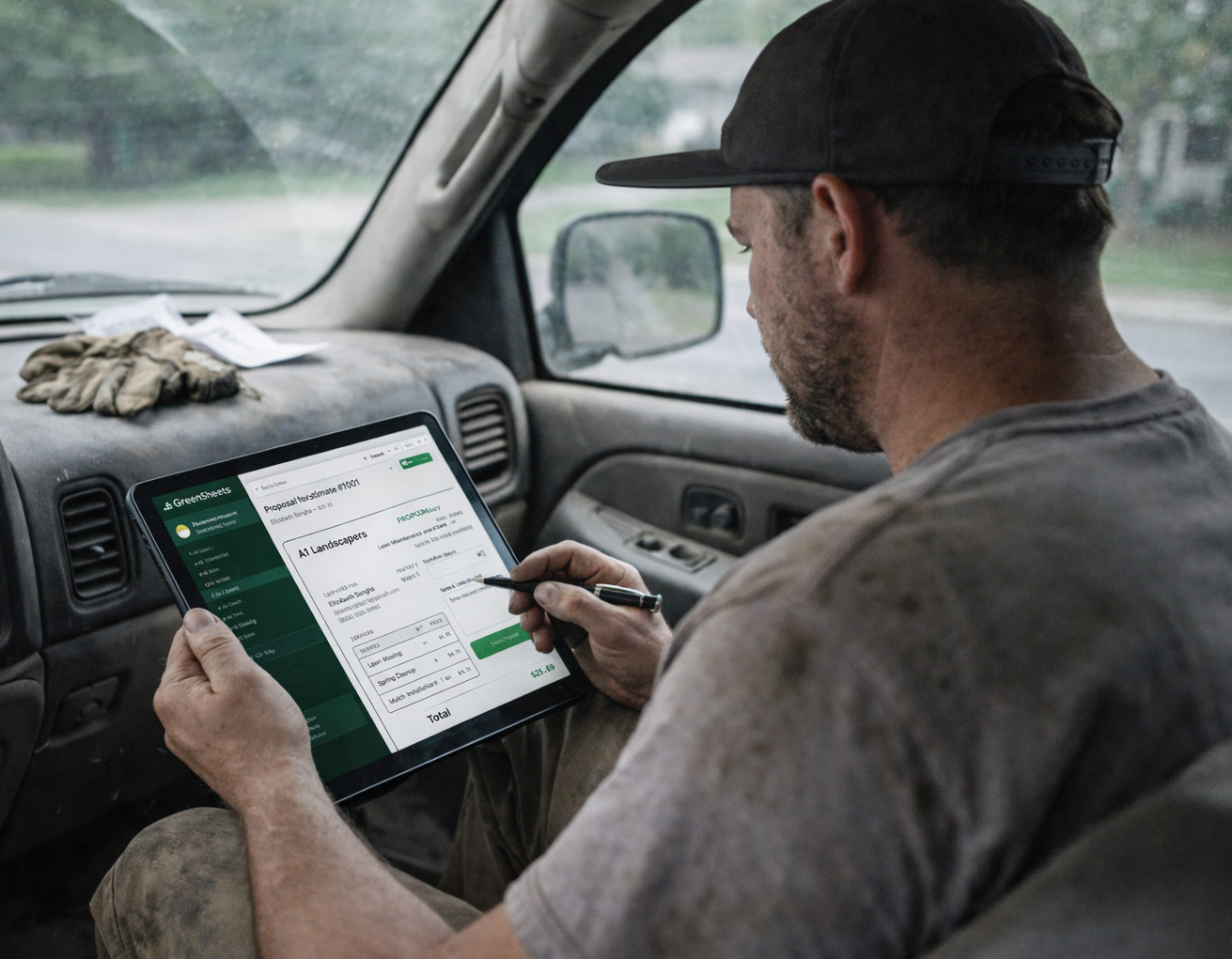
Modern landscape estimating software does not simply digitize your spreadsheet. It changes the fundamental workflow of how you price, propose, and track your work. The shift is not about trading one tool for another — it is about reclaiming time, recovering overhead on every bid, and building a system that gives you justified confidence in every number you send to a client.
Here is what that looks like when contractors make the switch.
Time savings that change your evenings and your weekends
The Aspire 2026 Technology Trends Report found that contractors on integrated estimating platforms are five times more likely to save 11 to 20 hours per week compared to those using manual tools (Aspire 2026 Technology Trends Report).
Those are not hypothetical hours. One contractor using ScopeTakeoff reported cutting commercial estimate time from 3 to 4 hours down to under 20 minutes per bid (ScopeTakeoff customer case study). A RapidQuote user reduced takeoff time from 5 to 6 hours to just 1 to 2 hours (RapidQuote customer case study). Southern Sun Landscaping began sending bids in 70 percent less time, which allowed them to send 40 percent more proposals and improve their win rate by 30 percent (Attentive.ai case study).
For most owner-operators, those reclaimed hours do not go toward more work. They go to dinner with family, a Saturday morning without paperwork, or a Monday that starts with a plan instead of panic. The value is not just financial — it is personal.
"Now I do not have to sit in the office for 2–3 hours after work, I go home to be with my family."
— SynkedUP customer
Overhead recovery built into every single bid — automatically
The difference between profitable contractors and struggling ones often comes down to whether overhead gets allocated to every job. Companies that use consistent estimating templates and production rates maintain 15 to 22 percent higher gross margins than those estimating ad hoc (SiteRecon, 2025).
Landscape estimating software embeds overhead recovery into your estimates automatically. When you set up your service catalog, you define your overhead rate once. From that point forward, every bid you create includes that cost — no manual calculation, no forgetting, no shortcuts under time pressure.
This is not a minor adjustment. When overhead accounts for 20 to 35 percent of your revenue and you are not allocating it consistently, you are effectively running each project at a hidden loss. The loss only becomes visible at year-end when the accountant tells you what happened. By then, the season is over and the money is gone.
Professional proposals and what they do to your close rate
Speed matters more than most contractors realize. Research from D-Tools found that proposals delivered within 14 days carry an 88 percent win rate. After 60 days, that rate drops to 69.6 percent (D-Tools, 2025 Year-in-Review Report). Yet only one in four contractors deliver their proposals within two weeks (D-Tools, 2025).
Landscaping proposal software generates a polished, branded proposal directly from your estimate — with accurate line items, clear scope of work, and professional formatting. No retyping numbers into a separate Word document. No PDF attached to an email with “see attached.” Clients can review, approve, and sign digitally.
Contractors using Bolster’s estimating platform reported winning 15 percent bigger jobs and closing 20 percent more often (Bolster). The pattern holds across platforms: faster, more professional proposals win more work and better work. The speed advantage alone puts you ahead of three-quarters of your competitors who take more than two weeks to follow up.
Real-time job costing: knowing your numbers before the invoice goes out
The most powerful capability of modern estimating software is not the estimate itself — it is the connection between estimated cost and actual job cost. When your system tracks labor hours, material expenses, and change orders against the original bid, you get a live picture of profitability as the work happens.
This is landscape job costing in practice. Instead of discovering a job lost money after it is complete, you see an overrun developing in real time. You can adjust crew allocation mid-project, flag scope changes with the client before they become disputes, or make operational decisions based on data rather than gut feeling.
Aspire clients who use integrated job costing are 34 percent more profitable than non-Aspire users, according to the Herring Group 2022 Landscape Industry Benchmark Report. The feedback loop between estimated and actual costs is the mechanism that turns estimating from seasonal guesswork into a repeatable system — one where every completed job makes the next estimate more accurate.
"Contractors on integrated platforms are 5x more likely to save 11–20 hours per week compared to manual-tool users."
— Aspire 2026 Technology Trends Report, Thrive Analytics
"We used to do takeoffs with a scale rule and a pencil which was very time consuming and now we have a much quicker takeoff time."
— RapidQuote customer
These capabilities are well-documented in industry research. But what matters most is whether real contractors — people running businesses like yours — are seeing these results in their own operations.

5. Real contractors, real results: switching to landscape bid software
Data tells part of the story. The rest comes from the contractors who have already made the switch from manual estimating to software-based systems. Their experiences cluster around three consistent themes: a measurable jump in profitability, meaningful time reclaimed, and a kind of financial confidence that changes how they run their businesses and live their lives.
Profitability transformations that change the trajectory of a business
The most dramatic shift contractors report after adopting estimating and job costing software is a measurable increase in net profit margin — not over years, but within months.
"My company went from an 8% net profit to a 30% net profit in the first 6 months."
— SynkedUP customer
"Since using SynkedUP we have more than doubled our net profit, paid off our trucks, and I am now paying myself as the owner."
— Jordan Daneker, Evolve Outdoor Living
"LMN has helped us grow our company by 36% to $5.3M at a 20% net profit last year."
— LMN customer
These are not marginal improvements. Going from 8 percent to 30 percent net profit on the same revenue means the difference between financial survival and building real equity. For a business generating $500,000 per year, that shift represents over $100,000 in additional annual profit — money that flows directly to the owner, to debt repayment, to equipment upgrades, or to building a cash reserve that makes the slow season less stressful.
The mechanism is straightforward. When you know your true costs on every job — materials, labor, overhead, and a defined profit margin — you stop accidentally giving work away. You price with precision instead of approximation. The profit was always available. The estimating system is what makes it visible and capturable.
Time reclaimed — and what contractors actually do with it
The second consistent pattern is time. Not just hours saved on the estimating process itself, but the downstream effect on daily stress and quality of life.
"I used to spend hours every night doing paperwork, planning the next day, and stressing about what might fall through the cracks."
— Keith Kalfas
"It is amazing because I know my quotes are accurate, it helps me understand where my pricing is at, and I do not loathe quoting anymore."
— SynkedUP customer
The time savings are real and measurable — recall that integrated-platform users are five times more likely to save 11 to 20 hours per week (Aspire 2026 Technology Trends Report). But the emotional shift matters just as much as the hours. When you trust your numbers, you stop second-guessing every bid you send. The low-grade anxiety that follows you home after work — did I price that job right? Did I forget to include disposal? Are we going to lose money on the Henderson project? — starts to fade.
That mental bandwidth is worth more than any time-tracking metric can capture. It is the difference between dreading the estimating process and approaching it with clarity.
Financial confidence that compounds over years
The third pattern is harder to quantify but unmistakable in contractor stories: confidence. Financial confidence changes how you make decisions, how you invest in your business, and how you sleep at night.
"3 years ago I was buying tools from Harbor Freight on a credit card. Today I wrote a check for $59,000 for an excavator attachment — no stress."
— SynkedUP customer
That trajectory — from credit card survival to writing five-figure equipment checks without anxiety — is the compound effect of knowing your numbers on every job for three consecutive years. Accurate estimating does not just improve a single bid. It builds a foundation of financial clarity that makes every subsequent business decision better: whether to take on a subcontractor, when to buy that new mower, how much to pay yourself, and when to say no to a job that does not meet your margin threshold.
The confidence extends beyond finances. Contractors who trust their pricing show up differently in client conversations. They present proposals without apologizing for the price. They negotiate from data, not from fear of losing the job. Professional pride and financial confidence feed each other.
These results are not unique to a single software platform. They are the predictable outcome of replacing guesswork with data-driven estimating. The question is not whether the approach works — the evidence is overwhelming. The question is what is stopping you from starting.
6. Your concerns about lawn care estimating software, answered honestly
Every contractor who has made the switch to estimating software had the same hesitations you might be weighing right now. The concerns are legitimate — they come from real experience and real constraints. Here are honest answers to the objections that come up most often.
"I cannot afford another software subscription right now"
This is the most common concern — and mathematically, the easiest to address.
If your business generates $300,000 in annual revenue and you are underpricing just 10 percent of your jobs by 10 percent, you are leaving approximately $3,000 per year in revenue you already earned but failed to capture. At around $79 CAD per month, GreenSheets costs under $950 CAD per year. One recovered underbid pays for the full annual subscription.
Now factor in the overhead allocation gap. If 20 to 35 percent of your revenue goes to overhead and you are not building that into every estimate, the amount you are subsidizing from your own margin dwarfs the cost of any software tool.
The real question is not whether you can afford the subscription. It is whether you can afford to continue estimating in a way that leaves money on the table with every fifth job.
"I am too busy to learn something new right now"
If you are too busy to evaluate your estimating process, that is precisely the signal that your current process is not scaling with your workload.
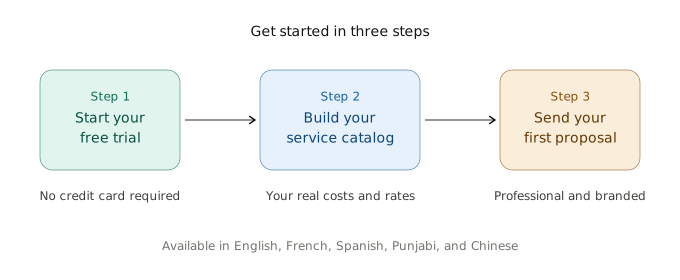
Modern landscape estimating software is built for contractors, not accountants or IT professionals. GreenSheets, for example, follows three core steps: set up your service catalog with your real costs and rates, build your estimate by selecting services and quantities, and send a professional proposal your client can approve and sign. Most contractors complete initial setup in one to two hours.
You do not need to migrate everything at once. Start with your very next new estimate. Run it through the software alongside your existing method if that feels safer. The Aspire 2026 data showed that contractors on integrated platforms save 11 to 20 hours per week at five times the rate of manual-tool users. The time invested in learning the tool comes back to you — compounded — within weeks, not months.
The busiest contractors are often the ones who benefit the most. The less time you have, the more valuable a faster estimating process becomes.
"My spreadsheet works fine for my size"
It might — today. If you are running a solo operation with a handful of repeat clients and a straightforward service list, a well-built spreadsheet can get the job done.
But consider two data points. First, 88 to 94 percent of spreadsheets contain at least one error (Ray Panko, University of Hawaii). You may not be aware of what your spreadsheet is getting wrong, because it does not tell you. Second, more than half of contractors using manual tools believe their current systems will restrict their growth over the next five years (Aspire 2026 Technology Trends Report).
A spreadsheet does not warn you when it becomes a bottleneck. It just quietly limits what you can do next. If you have any plans to add crew members, take on larger commercial projects, or push past your current revenue plateau, the ceiling will arrive sooner than you expect — and switching systems under pressure is harder than switching when you have a moment to breathe.
"What about migrating my existing estimates and data?"
You do not need to migrate anything to begin. Start with new estimates in the software and reference your existing spreadsheets or paper records as needed for historical data. Over time, as you build out your service catalog and refine your production rates within the tool, the old templates naturally become unnecessary.
The goal is not to replicate your spreadsheet inside a software platform. The goal is to build a better system going forward — one that includes overhead allocation, accurate cost tracking, and professional proposals from the start.
GreenSheets is available in English, French, Spanish, Punjabi, and Chinese, so if you or your team operate in more than one language, the tool works with you rather than against you. And your data remains yours — portable and accessible even if you ever decide to cancel.
The concerns are valid. The answers are practical. The only remaining question is what the first step actually looks like.
7. How to start with landscape estimating software in three steps
Switching to estimating software does not require a weekend-long setup session, a paid consultant, or a complete overhaul of your business operations. The process is simpler than most contractors expect — and the first step takes less than five minutes.
Step 1 — Start your free trial and explore the tool with real work
Go to greensheets.app and create your account. No credit card is required. The free trial gives you full access to Pro features, so you can evaluate the tool using an actual job — not a hypothetical demo scenario.
GreenSheets is built in five languages — English, French (Quebec), Spanish, Punjabi, and Simplified Chinese — so you can work in the language you are most comfortable with from the first login. If you serve a multilingual market or manage crews who speak different languages, that accessibility is built in from day one.
Step 2 — Build your service catalog using your real numbers
Enter the services you perform most frequently: weekly lawn maintenance, mulch installation, hedge trimming, spring and fall cleanups, or whatever makes up the core of your work. For each service, define your material costs, labor rates, crew size defaults, and your overhead allocation percentage.
This step takes most contractors one to two hours. Once your service catalog is built, every future estimate pulls from these verified, current numbers. No more retyping rates from memory. No more guessing at material costs. No more accidentally forgetting to include overhead. Your pricing becomes consistent, accurate, and repeatable across every bid.
Step 3 — Send your first professional proposal and see the difference
Build an estimate for an upcoming job using your new catalog. Review the full cost breakdown before you send — materials, labor, overhead, and profit all visible on one screen. Then generate a branded proposal, send it to your client, and track whether it has been opened, reviewed, or approved.
That is it. Three steps. Your first estimate in the new system can be completed today. You do not need to commit to switching everything overnight. Just run one real estimate through the tool and compare the experience — the speed, the accuracy, the professionalism of the output — to your current process. Let the difference speak for itself.
Every week you continue estimating the old way is another week of leaving money on jobs you already won. The Aspire 2026 research is unambiguous: contractors using manual tools are stuck at the bottom of the profitability range, and they know it — over half expect their current systems to limit their growth.
The cost of the software is measurable. The cost of inaction compounds silently, season after season.
Sources and references
- Aspire 2026 Technology Trends Report — Conducted by Thrive Analytics, 500+ commercial landscaping professionals. Published April 2026. Available via Aspire Software (youraspire.com). Key findings: manual-tool users report 0% above 15% margins; spreadsheet users cluster at 4–7%; integrated platform users 5x more likely to save 11–20 hrs/week; 49% of Aspire users forecast profit growth; 40% of manual users forecast profit decline; >50% of manual users expect systems to restrict growth.
- IBISWorld — Landscaping Services in the US (2025) — Industry revenue of $188.8 billion, approximately 692,000 businesses, industry profit margin of 11.9%. ibisworld.com
- National Association of Landscape Professionals (NALP) — Industry size and business count data corroborating IBISWorld figures. landscapeprofessionals.org
- Greg Herring, CEO, The Herring Group — Industry average net profit benchmarked at 4.6%. herring-group.com
- Herring Group 2022 Landscape Industry Benchmark Report — Aspire clients 34% more profitable than non-Aspire users. herring-group.com
- Grow Group, Inc. (2025) — "Approximately 50% of landscaping businesses fail within the first five years." growgroupinc.com/the-grow-group-blog/profit-margins-for-landscaping-businesses-explained
- Total Landscape Care via Method.me — Landscaping businesses profit on approximately 60% of jobs; ~20% break even; ~20% are losses. method.me
- Tony Bass, Super Lawn Trucks — Average lawn and landscape companies consistently underprice 20% of their jobs, based on reviewing 400+ companies. superlawntrucks.com
- 2023 Lawn & Landscape Survey via SiteRecon — 52% of contractors missed profitability targets due to inaccurate overhead allocation. siterecon.ai/blog/overhead-costs-a-complete-guide-for-landscaping-businesses
- NALP via SiteRecon — Overhead costs typically 20–35% of landscaping revenue; up to 40% for businesses under $1M. siterecon.ai
- SiteRecon (2025) — Companies using consistent estimating templates and production rates maintain 15–22% higher gross margins. siterecon.ai
- Autodesk and FMI Corporation — "Harnessing the Data Advantage in Construction," 3,900+ respondents. Bad data may have cost global construction $1.85 trillion in 2020; $88.69 billion (14%) of rework attributed to bad data. construction.autodesk.com / fmicorp.com
- Ray Panko, University of Hawaii — Field audits finding 88–94% of spreadsheets contain at least one error. panko.com/ssr/
- D-Tools, 2025 Year-in-Review Report — Proposals delivered within 14 days: 88% win rate. After 60 days: 69.6%. Only 1 in 4 contractors deliver proposals within two weeks. Based on 250,112 proposals analyzed. d-tools.com
- RapidQuote — Up to 75% of estimates do not result in a landscaping job (citing university research). Customer case study: takeoff time reduced from 5–6 hours to 1–2 hours.
- ScopeTakeoff — Customer case study: commercial estimate time reduced from 3–4 hours to under 20 minutes.
- Attentive.ai — Southern Sun Landscaping case study: bids sent in 70% less time, 40% more bids submitted, win rate improved by 30%.
- Bolster — Contractors using Bolster win 15% bigger jobs and close 20% more often. bolster.us
- SynkedUP — Multiple customer testimonials cited. Founders quote: "We were drowning in software. Nothing was connected." synkedup.com
- Jordan Daneker, Evolve Outdoor Living — "Since using SynkedUP we have more than doubled our net profit, paid off our trucks, and I am now paying myself as the owner."
- LMN customer testimonial — "LMN has helped us grow our company by 36% to $5.3M at a 20% net profit last year."
- Keith Kalfas — "I used to spend hours every night doing paperwork, planning the next day, and stressing about what might fall through the cracks."
- Anonymous contractors, LawnSite forum — Two community testimonials cited regarding financial losses from tracking errors and absorbing costs to avoid client conflict.